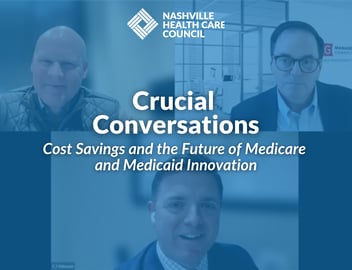

The Nashville Health Care Council’s May 14th Crucial Conversations event explored the Transforming Episode Accountability Model (TEAM) and the challenges healthcare leaders face in effective implementation. The conversation was moderated by Igor Enin, Director at PwC, and featured Veronica Elders, Interim Chief Executive Officer & Chief Nursing Officer of Nashville General Hospital, Eddie Qureshi, CEO of Rainfall Health, and Dr. Darren Swenson, President of Post Acute Care at TeamHealth.
The timely discussion examined how the Transforming Episode Accountability Model (TEAM) is accelerating the shift from procedure-based care to accountability for the full patient journey, including the critical post-discharge period. Together, panelists explored what this shift will require in practice: stronger partnerships across the care continuum, disciplined operational execution, and a shared commitment to improving outcomes while managing cost and complexity.
Beginning in 2026, TEAM will be mandatory for select hospitals and will run for five years, signaling a significant long-term shift in how Medicare approaches episode-based payment and accountability. In total, 721 hospitals nationwide were selected to participate in the model, including 30 hospitals across Tennessee, bringing the impact of this transition closer to home for healthcare organizations across the state.
TEAM will include three participation tracks, with Track 1 offering no downside risk and lower levels of reward during the first year of participation, or up to three years for safety net hospitals.
Accountability Extends Beyond the Procedure
At the center of the discussion was a simple but significant shift. Under TEAM, the episode of care does not end when the procedure is complete. The panelists emphasized that TEAM reinforces a core operational reality: patient outcomes depend on what happens across the full care continuum, not within a single setting alone.
For hospital leaders, that means discharge becomes a point of transition rather than closure. Elders described care transition work already underway at Nashville General Hospital, including bedside discharge, follow-up appointments scheduled before patients leave, and a community care team that checks in after discharge to identify barriers such as transportation or missed appointments. Connecting that same idea to the post-acute environment, Swenson highlighted that success depends on hardwiring communication and accountability between hospitals, surgeons, and post-acute providers. For leaders, TEAM does not introduce the need for coordinated care, but it raises the stakes for executing it consistently. Organizations that can build reliable transition processes, align partners, and stay focused on recovery after discharge will be better positioned to manage quality, cost, and patient experience under the model.
Partnerships Become the Operating Model
TEAM also puts new pressure on one of healthcare’s most persistent challenges: coordination between acute and post-acute care. Swenson stated that hospitals and post-acute providers cannot approach TEAM as a top-down referral relationship. Instead, success will require both sides to build trust, understand each other’s operating realities, and align around shared expectations for patient outcomes. He pointed to practical barriers that complicate that work, including variation in post-acute resources, limited data infrastructure, and the fact that close to 15% of post-acute care facilities still lack an EMR.
Elders echoed the need to bring post-acute providers more fully into the care continuum, noting that hospitals are now accountable for what happens beyond their walls. Qureshi added that as hospitals assume greater financial responsibility, they should expect more from every partner influencing the patient’s recovery. The broader takeaway was that partnership under TEAM is not simply about collaboration in principle. It is about creating a more accountable operating model for the full episode of patient care and testing whether healthcare organizations can turn cooperation across settings into a consistent operating discipline.
Readiness Depends on Execution
Panelists highlighted that TEAM readiness will depend on more than understanding the model. It will require leaders to know their numbers, understand financial exposure, identify the right partners, and build the structure needed to turn data into action. While Qureshi pointed out the urgency of financial and operational readiness, Swenson focused on the infrastructure needed for acute and post-acute collaboration, and Elders grounded the discussion in the patient-centered processes already shaping transitions of care.
Qureshi framed TEAM as a clinical, operational, and financial framework, with reimbursement tied to quality, patient satisfaction, outcomes, and cost. He noted that many leaders are still working through how to get started while balancing competing priorities across the enterprise. From his perspective, readiness begins with understanding what the model means for each organization, where the financial opportunity or exposure sits, and what resources are needed to execute effectively. He also pointed to a significant data challenge: even robust acute care hospitals may have direct visibility into only about 40% of the episode data, leaving the remaining 60% dependent on stronger partnerships, better infrastructure, and more timely information.
Swenson brought the discussion back to execution, emphasizing the importance of structure, process, and outcome. In his view, the first year of TEAM should be used to build the foundation between acute and post-acute partners, including communication channels, resource alignment, and shared accountability. Once that structure is in place, organizations can use data to improve performance rather than simply assign penalties. He noted that by the end of 2026, success may be as foundational as getting acute and post-acute partners to the same table.
According to Elders, this kind of readiness can begin before a model requirement appears on a checklist. At Nashville General Hospital, investments in bedside discharge, follow-up by a community care team, and a multidisciplinary care model were already creating the type of infrastructure TEAM will require, including reducing the hospital’s 30-day admission rate to 7% for a vulnerable patient population. Her perspective reinforced that readiness is not only about data systems or financial modeling. It is also about building repeatable processes that help patients move safely into the next phase of care.
Looking Ahead
The panelists underscored that TEAM represents more than a new payment model. It is a leadership test for healthcare organizations working to align clinical care, operational infrastructure, financial accountability, and patient experience across the full episode of care. The conversation pointed to several priorities for successful implementation, including strengthening acute and post-acute partnerships, improving data visibility, building reliable care transition processes, and creating shared expectations for performance across every organization involved in a patient’s recovery.
The discussion also reinforced that the broader shift toward episode-based accountability is not slowing down. While federal models, risk arrangements, and reporting requirements will continue to evolve, the central challenge remains consistent: healthcare leaders must build systems that support patients beyond individual encounters and across settings. TEAM offers an opportunity to move coordination from aspiration to execution, with the ultimate goal of improving outcomes, reducing avoidable utilization, and creating a more connected experience for patients.


About the Nashville Health Care Council
The Nashville Health Care Council strengthens and elevates Nashville as The Healthcare City. With a $68 billion economic impact and 333,000 jobs locally, Nashville’s healthcare ecosystem is a world-class healthcare hub. Founded in 1995, the Council serves as the common ground for the city’s vibrant healthcare cluster. The Council offers engagement opportunities where the industry’s most influential executives come together to exchange ideas, share solutions, build businesses and grow leaders.