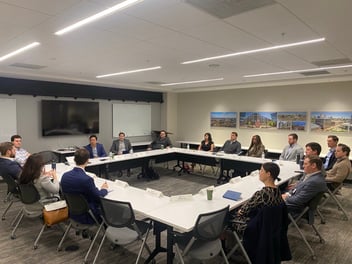

Day One of the inaugural Council Healthcare Foundations program set the stage for a deeper understanding of the forces shaping the U.S. healthcare system. Designed for mid-level leaders looking to strengthen their industry knowledge, the program introduces participants to the full care continuum, explores how innovation and policy address systemic challenges, and clarifies how payors, providers, investors, and disruptors work together to drive outcomes. Guided by leading experts, the first day offered a comprehensive look at the dynamics influencing healthcare today. Read more from the day’s discussions below.
Michael Burcham: Key Players in Healthcare
Professor for the Practice of Management at Vanderbilt’s Owen Graduate School of Management, Chief of Strategy and Talent Development at Shore Capital and Council Board Member, Michael Burcham, provided a profound examination of the power structures within the healthcare ecosystem, emphasizing the importance of recognizing which players held influential positions and how these dynamics shaped the industry.
Identifying the Power Players
Michael Burcham kicked off the day by focusing on various entities that wielded power in healthcare, including insurers, Integrated Delivery Networks (IDNs), and decision-makers within the system. He explained that insurance companies often held significant sway due to their role in generating and managing revenue streams. In particular, some markets like Alabama were dominated by insurers with large market shares—Blue Cross being a prime example—resulting in considerable power in determining healthcare access and affordability. Conversely, he pointed out that in smaller or rural markets, a single hospital system might wield substantial influence as the primary provider of healthcare services. This variability created a dynamic landscape where power could shift dramatically based on geography and local market conditions.
The Role of Innovation in Shifting Power
Burcham highlighted that innovation was a double-edged sword in the healthcare environment. While numerous medical advances could revolutionize patient care, he noted that many remained on the shelf due to lack of funding or the challenges posed by navigating complex reimbursement landscapes. These innovations—such as new medical procedures or cutting-edge therapies—often struggled to see the light of day because they couldn't establish a clear pathway from development to market. Burcham likened this to having a "museum of discoveries," where many potential breakthroughs awaited viable opportunities for implementation. He posited that strategically navigating these challenges was essential for fostering partnerships that could advance healthcare delivery.
Financial Structures and Strategic Provider Decisions
Burcham delved into the intricate financial structures affecting healthcare providers. By explaining the relationship between insurers, self-insured employers, and specialty medical practices, he shed light on the complex financial interplay that determined how power dynamics manifested in revenue generation and healthcare delivery. He elaborated on the strategic decisions healthcare providers must make—whether to form partnerships with hospitals, align with health insurance entities, or join private equity-backed networks—in navigating financial landscapes that were frequently imbalanced and challenging.
In summary, Michael Burcham's insights into the healthcare landscape emphasized a nuanced understanding of power dynamics, innovation challenges, and financial strategies that healthcare professionals had to navigate. The intricate interplay between these elements dictated the levers of influence within the industry, requiring stakeholders to adopt dynamic approaches to balance power and pursue opportunities for growth and efficiency.
Whitney Staub-Jergens: A Walk Through the Care Continuum
Vice President of Transformation Operations for HCA Healthcare’s Department of Digital Transformation & Innovation and a member of the Council Fellows Class of 2025, Whitney Staub-Jergens shifted the focus to patient experience, exploring how healthcare leaders could better design systems to meet patient needs effectively.
Personal Stories and Empathy
Next, Whitney Staub-Jergens shared personal anecdotes from her time as a nurse to underscore the transformative power of empathy and patient-centered care. Her journey into nursing was sparked by a compassionate interaction with a nurse during a personal health crisis, illustrating the profound impact such moments could have on patients. She emphasized that recognizing the emotions and fears of individuals encountering the healthcare system could drive substantial improvements in patient experience and outcomes.
Systemic Challenges and Potential Solutions
She explored the systemic challenges patients faced, particularly when navigating complex healthcare scenarios like transplant evaluations. She used the example of John, a fictional 58-year-old patient, to discuss the overwhelming factors affecting patients, such as medical jargon, financial concerns, and the intricacies of moving through different stages of care from entry to diagnosis and treatment. Staub-Jergens highlighted the need for better coordination between healthcare providers and systems to improve patient flow and outcomes.
Design Decisions with Impact
According to Staub-Jergens, design decisions in healthcare systems must prioritize patient and provider needs. She advocated for leveraging technology like AI and large language models to enhance communication and empathetic care, as these could offer significant efficiencies and improvements in how care was delivered. Tools like these could facilitate better handoffs between healthcare providers, ensuring that patients receive continuous and coherent care throughout their journey.
Larry VanHorn: Addressing Economic Challenges and Technological Opportunities
Professor of Economics and Strategy, Emeritus at Vanderbilt University, Larry VanHorn took a critical look at the economic and structural issues facing the healthcare industry, advocating for significant reforms.
Economic Realities and Cross-Subsidization
To close out day one, Larry VanHorn pointed out the inefficiencies and distortions in how healthcare was financed, arguing that the current model didn't align with traditional insurance principles. He critiqued the system’s tendency to bundle routine care with catastrophic coverage under the same "insurance" umbrella, which skews costs and incentives. He warned about cross-subsidization, where the healthy indirectly subsidize care for the sick, leading to an economically inefficient system that burdens certain groups unfairly.
The Fiscal Imbalance
VanHorn painted a stark picture of the U.S. government's financial situation, emphasizing the unsustainable trajectory of healthcare spending, specifically in Medicare and Medicaid programs. He stressed the urgent need for reform, particularly since the current model was expected to burden future generations with debt and diminished financial flexibility. His insights highlighted the pressing need to reorient fiscal policies and explore innovative funding models to alleviate the growing financial strain.
The Role of AI and Innovation
Despite the challenges, VanHorn saw hope in technological advancements, particularly AI. He proposed that AI could reshape healthcare by increasing efficiency, reducing costs, and making healthcare products and services more affordable and accessible. AI’s potential to revolutionize areas such as patient diagnostics and individualized medicine could lead to significant cost savings and improve the quality of care across the board. VanHorn envisioned a future where technology enabled more personalized and efficient healthcare delivery, transforming the industry into a model that was financially and operationally sustainable.
Developing a Clearer View of the Healthcare Ecosystem
The Healthcare Foundations Program provided a space for leaders new to the industry to develop a more comprehensive understanding of how the healthcare system operates and the forces that shape it. By breaking down topics like power dynamics, patient experience, economic pressures, and technological change, speakers helped participants build clarity and context around the issues driving the system today. The program offered a grounded, accessible foundation, moving participants from surface-level understanding to a more connected view of how patients, providers, payors, and innovators interact across the continuum.


About the Nashville Health Care Council
The Nashville Health Care Council strengthens and elevates Nashville as The Healthcare City. With a $72.1 billion economic impact and 372,160 jobs locally, Nashville’s healthcare ecosystem is a world-class healthcare hub. Founded in 1995, the Council serves as the common ground for the city’s vibrant healthcare cluster. The Council offers engagement opportunities where the industry’s most influential executives come together to exchange ideas, share solutions, build businesses and grow leaders.